Artificial Intelligence (AI) is no longer a futuristic concept limited to science fiction movies. Today, AI has become an integral part of our daily lives, influencing how we communicate, shop, travel, work, learn, and even manage our health. From voice assistants like Siri and Google Assistant to personalized recommendations on Netflix and Amazon, AI is quietly working behind the scenes to make life easier and more efficient.
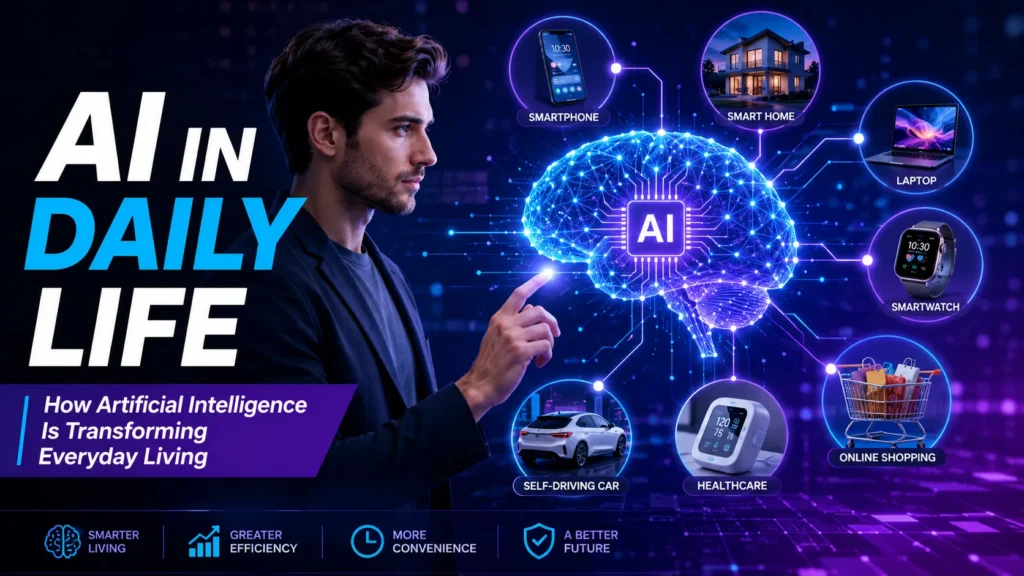
In this article, we will explore how AI is used in daily life, its benefits, real-world applications, challenges, and what the future holds for artificial intelligence.
What Is Artificial Intelligence?
Artificial Intelligence refers to the simulation of human intelligence in machines that are programmed to think, learn, reason, and make decisions. AI systems can analyze large amounts of data, identify patterns, and perform tasks that traditionally require human intelligence.
Some common AI technologies include:
- Machine Learning (ML)
- Natural Language Processing (NLP)
- Computer Vision
- Deep Learning
- Robotics
- Predictive Analytics
These technologies power many of the digital tools and services we use every day.
AI in Daily Life: Common Examples
Most people interact with artificial intelligence multiple times a day without even realizing it. Here are some of the most common examples.
1. Voice Assistants
Voice assistants such as Siri, Google Assistant, and Alexa use AI to understand spoken language and respond to user commands.
Key functions include:
- Setting reminders
- Playing music
- Answering questions
- Managing smart home devices
- Making phone calls
These assistants use natural language processing to understand human speech and provide accurate responses.
2. Personalized Recommendations
Have you ever noticed how Netflix suggests shows you might enjoy or how Amazon recommends products based on your interests?
AI algorithms analyze:
- Browsing history
- Purchase behavior
- Viewing patterns
- Search activity
This helps platforms provide highly personalized recommendations, improving user experience and engagement.
3. Social Media Platforms
Artificial intelligence plays a major role in social media platforms like Facebook, Instagram, TikTok, and LinkedIn.
AI helps by:
- Curating news feeds
- Recommending content
- Detecting spam accounts
- Identifying harmful content
- Targeting advertisements
These systems continuously learn from user behavior to deliver more relevant content.
4. Smart Navigation and Transportation
Google Maps, Apple Maps, and ride-sharing apps use AI to provide accurate navigation and traffic predictions.
AI can:
- Analyze traffic conditions
- Suggest faster routes
- Estimate arrival times
- Optimize fuel efficiency
- Improve logistics management
This makes commuting and transportation more convenient.
5. Online Shopping
E-commerce platforms rely heavily on AI to enhance customer experiences.
AI-powered features include:
- Product recommendations
- Chatbots
- Dynamic pricing
- Inventory management
- Fraud detection
As a result, customers receive a more personalized shopping experience while businesses improve sales and operational efficiency.
AI in Healthcare
Healthcare is one of the industries experiencing the biggest transformation through artificial intelligence.
Medical Diagnosis
AI systems can analyze medical images and patient data to help doctors identify diseases more accurately.
Applications include:
- Cancer detection
- Heart disease prediction
- Early diagnosis of neurological disorders
- Medical imaging analysis
Virtual Health Assistants
AI-powered healthcare assistants can:
- Schedule appointments
- Answer health-related questions
- Monitor symptoms
- Provide medication reminders
These tools improve patient engagement and accessibility.
Wearable Health Devices
Fitness trackers and smartwatches use AI to monitor:
- Heart rate
- Sleep patterns
- Activity levels
- Blood oxygen levels
Users receive personalized health insights and recommendations.
AI in Education
Artificial intelligence is changing how students learn and educators teach.
Personalized Learning
AI-powered educational platforms can adapt lessons according to a student’s learning pace and performance.
Benefits include:
- Customized study plans
- Instant feedback
- Better learning outcomes
- Improved engagement
Intelligent Tutoring Systems
AI tutors provide students with personalized support and explanations, helping them understand difficult concepts more effectively.
Automated Administrative Tasks
Schools and universities use AI to automate:
- Grading
- Attendance tracking
- Student assessments
- Administrative workflows
This allows educators to focus more on teaching.
AI in the Workplace
Businesses across industries are using AI to increase productivity and efficiency.
Automation of Repetitive Tasks
AI can automate routine activities such as:
- Data entry
- Scheduling
- Email management
- Customer support
This saves time and reduces human error.
AI-Powered Customer Service
Many companies use chatbots and virtual assistants to provide 24/7 customer support.
Advantages include:
- Faster response times
- Reduced operational costs
- Improved customer satisfaction
Data-Driven Decision Making
AI analyzes large datasets to provide actionable insights that help organizations make smarter business decisions.
Benefits of AI in Daily Life
Artificial intelligence offers numerous benefits that improve both personal and professional life.
Increased Efficiency
AI automates repetitive tasks, allowing people to focus on more valuable activities.
Better Personalization
From shopping recommendations to learning experiences, AI delivers highly personalized services.
Improved Accuracy
AI systems can process vast amounts of data with remarkable precision, reducing errors.
Enhanced Convenience
Smart devices and virtual assistants simplify everyday activities, saving time and effort.
Faster Problem Solving
AI can analyze information quickly and generate solutions much faster than traditional methods.
Challenges and Concerns of AI
Despite its advantages, AI also presents several challenges.
Privacy Issues
Many AI systems rely on collecting user data, raising concerns about privacy and data security.
Job Displacement
Automation may reduce demand for certain jobs, requiring workers to develop new skills.
Bias in AI Systems
AI models can inherit biases from the data they are trained on, leading to unfair outcomes.
Dependence on Technology
Excessive reliance on AI could reduce human decision-making abilities in some situations.
The Future of AI in Everyday Life
The future of artificial intelligence looks incredibly promising. As AI technology continues to evolve, we can expect:
- Smarter virtual assistants
- Advanced healthcare solutions
- Autonomous vehicles
- Personalized education systems
- Intelligent smart homes
- Improved cybersecurity systems
AI will likely become even more integrated into daily activities, making life more efficient, connected, and convenient.
How to Prepare for an AI-Driven Future
To thrive in an AI-powered world, individuals should focus on:
- Digital literacy
- Critical thinking
- Problem-solving skills
- Continuous learning
- AI awareness and understanding
Learning how AI works can help people adapt to technological changes and take advantage of new opportunities.
Conclusion
Artificial Intelligence is transforming daily life in ways that were unimaginable just a few years ago. From voice assistants and online shopping to healthcare, education, and transportation, AI is making everyday activities faster, smarter, and more efficient.
While challenges such as privacy concerns and job displacement remain important issues, the benefits of AI are undeniable. As technology continues to advance, artificial intelligence will play an even greater role in shaping the future of society.
Understanding AI and embracing its potential can help individuals and businesses stay ahead in an increasingly digital world.